
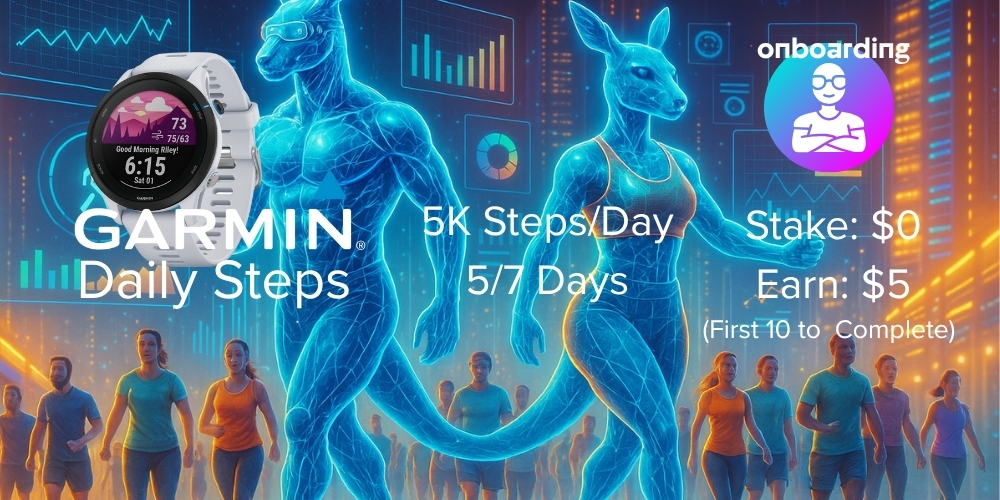
Gist: Your step challenge failed because it was too long, too hard, steps-only, and honor-system. Fix those four things and you get 3-4x better completion.
The Predictable Failure Pattern
Every office step challenge follows the same trajectory. The first week feels like a movement. The second week feels like a chore. By week three, 60-70% of participants have stopped logging steps, and the leaderboard has calcified into the same 3-4 names.
This is not a motivation problem. It is a design problem. And the data tells us exactly what is wrong:
- 10,000 steps is too high for 60%+ of office workers. The CDC reports the average American walks 3,000-4,000 steps per day. Asking sedentary workers to triple their output on day one creates immediate failure.
- 30-day challenges are 2-3x too long. Habit formation research (European Journal of Social Psychology, Lally et al.) shows it takes an average of 66 days to form a habit — but that does not mean a 30-day challenge builds one. Challenge fatigue sets in around day 10-14.
- Steps-only excludes 35%+ of active employees. Cyclists, swimmers, gym-goers, and yoga practitioners see zero credit for their existing exercise. They disengage immediately.
- Self-reporting kills trust. When people self-report steps, over-reporting averages 20-30% (International Journal of Behavioral Nutrition, 2021). Other participants notice, lose trust, and quit.
The Fix: Four Changes, 3-4x Better Results
- Lower the daily goal to 4,000-5,000 steps (or equivalent activity). Set it where 70% of your workforce can achieve it with moderate effort. You want 70%+ completion, not 10% competition.
- Shorten to 14 days. Two weeks is long enough to build momentum, short enough to maintain engagement. Run 4-6 challenges per year instead of 1-2.
- Add 2-3 activity options. Let employees choose steps, running, cycling, or bodyweight exercises. Participation increases 40-60% with activity choice.
- Use tracker verification and add $10-$25 stakes. Objective data eliminates disputes. Financial stakes eliminate casual sign-ups who never intended to participate. Together, they produce 70-85% completion rates.
Conclusion
Office step challenges fail for fixable reasons. Lower the goal, shorten the duration, add activity choice, verify with real data, and add stakes. The evidence from behavioral economics and workplace wellness research is unambiguous: these changes produce 3-4x better outcomes. Stop repeating the same failed formula. Design for completion.
Build a better office challenge
Create a Cadoo challenge with the right goal, the right length, and real accountability. Your team will actually finish this one.
Start a Step ChallengeFrequently Asked Questions
Why do most office fitness challenges fail?
Four reasons: goals are too high (10,000 steps is 2-3x most office workers daily activity), duration is too long (30+ days causes fatigue by week 2), only steps are offered (excludes cyclists, swimmers, gym-goers), and self-reporting kills trust and accountability.
What is the ideal step goal for an office challenge?
4,000-5,000 steps per day. This is achievable for 70%+ of office workers with moderate effort, which is the threshold for high completion rates. You can always increase goals in future challenges.
How often should a company run fitness challenges?
4-6 times per year with 2-3 week durations. Frequent short challenges outperform infrequent long ones in both participation and health outcomes.
Are you a fitness brand? Create your own branded fitness challenge at https://cadoo.games/cyoc
Cadoo works for everyone — whether you're a fitness brand looking to boost fitness brand marketing and engagement through branded fitness challenges, a corporate wellness program manager building employee wellness and workplace fitness challenge initiatives for team building fitness and employee engagement, a personal trainer or fitness professional motivating clients through group fitness and coaching, or a family looking for a family fitness challenge and community fitness experience. With real money on the line, Cadoo is the ultimate fitness motivation and workout accountability tool — the fitness challenge app where you get paid to exercise with money motivation fitness. Challenge your friends in a group fitness challenge, try fitness with friends, or start a neighborhood fitness movement. For brands, explore fitness sponsorship and fitness brand activation opportunities with fitness instructor partnerships.
Questions? Contact Tim Parsa, Co-Founder and CEO of Cadoo — the fitness gaming platform. Reach out at tim@cadoo.io


